Ordering winter underwear from Sears meant supplying two measurements: chest and waist. Beside the illustration were separate offer numbers and prices for one garment, one set and two sets. There was no drop-down menu to check the selection. The shopper had to describe the intended purchase correctly.
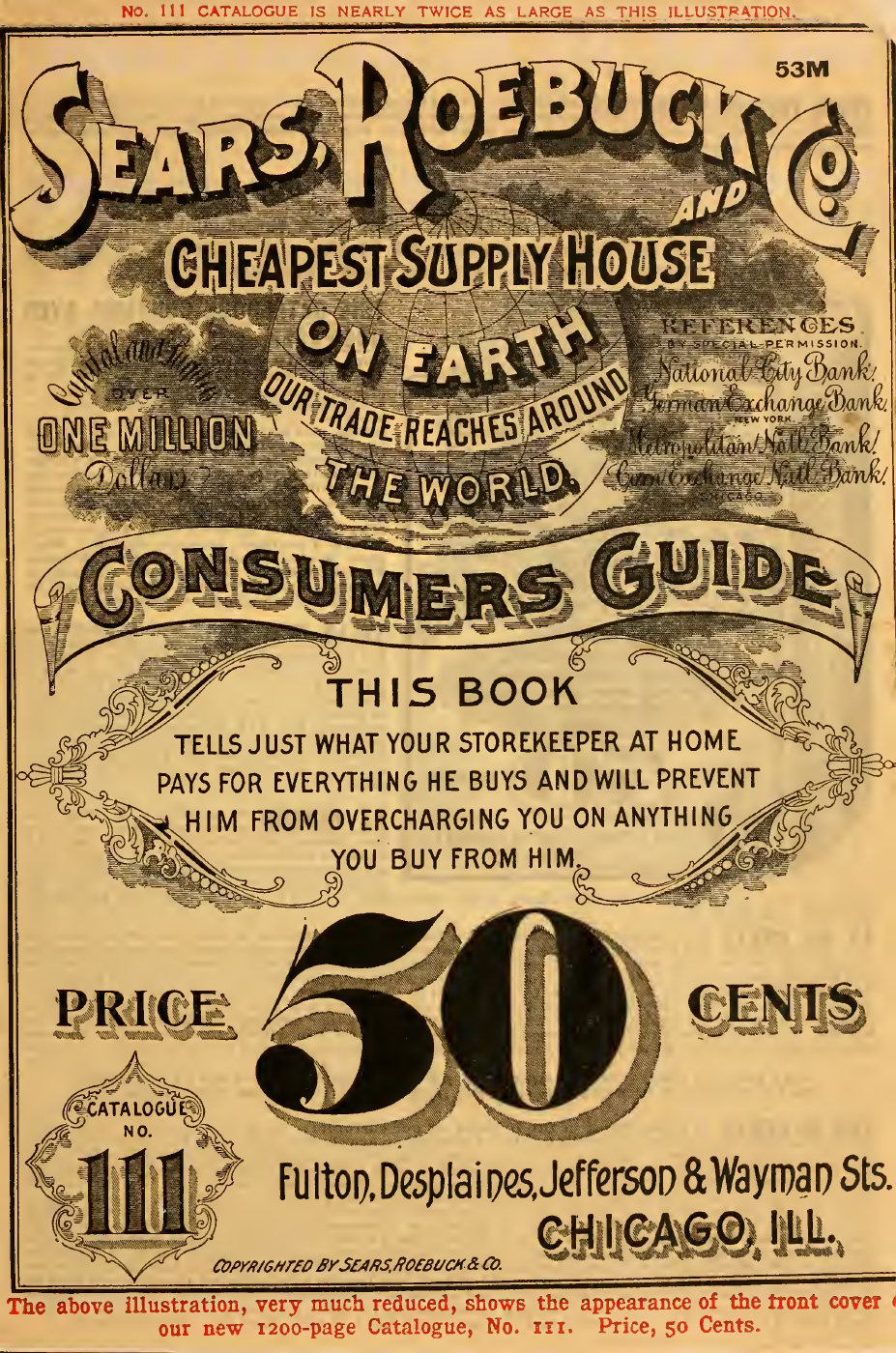
Those instructions survive in Consumers guide, a promotional booklet published by Sears, Roebuck and Company and held by the Winterthur Museum Library. The digitized item is dated circa 1901. It reveals more than the goods on offer: it shows the work a remote shopper had to do, from finding information and choosing a version to submitting an order and waiting for shipment.
First, sell the catalog
The first page prominently displays a price of 50 cents. It advertises the larger catalog No. 111, which Sears described as a 1,200-page publication. The scan available today is much shorter: its 54 pages form a promotional booklet, not the entire advertised catalog.
Sears justified charging for the catalog by pointing to printing and mailing costs. In the company's account, people who actually bought goods ended up paying, through merchandise prices, for free copies sent to people who never ordered. Charging for the book supposedly allowed those prices to fall. This was a sales argument, not an independently verified cost calculation or proof that Sears undercut every competitor.
A picture was not enough
Printed page 1, the fifth page of the PDF, lists separate sample books. One for custom-made men's clothing offered fabric samples, fashion illustrations, a tape measure, order forms and measuring instructions for 10 cents. Other options included fabric swatches for ready-made clothing and wallpaper samples.
These objects supplemented descriptions where a printed picture could not convey a material or establish fit. That detail matters: shopping at a distance did not necessarily mean choosing from images alone. Before ordering, a customer could have fabric swatches, a tape measure and measuring instructions sent by mail.
Printed page 47, page 51 of the PDF, provides a concrete example. The underwear offer used 53M102 for one garment, 53M104 for a shirt-and-drawers set and 53M106 for two complete sets. Two sets were advertised at $1.68. Buyers were separately reminded to specify sizes for both the upper and lower garments. The offer number and measurements did some of the work now handled by an order form on a screen.
Mail order did not always mean postal delivery
The same advertisement promised to send the underwear by express carrier. Elsewhere, the booklet discussed delays and customers going to a railroad or express office to collect their goods. Posting an order and transporting the merchandise were separate parts of the transaction. It would be misleading to imagine every mail-order purchase arriving as a parcel at the buyer's door.
The US National Postal Museum connects the expansion of catalog shopping with improvements in transport and postal services. Experimental Rural Free Delivery began in 1896; domestic Parcel Post started on January 1, 1913. These were distinct developments, not one unchanged service operating throughout the period.
A return promise is not a returns record
In the underwear advertisement, Sears offered dissatisfied customers a return at the company's expense and their money back. For someone unable to try on the garments in a store, the purpose was straightforward: the seller explained what could happen if the purchase disappointed.
The advertisement does not tell us how quickly refunds arrived or how many customers used the offer. Answering those questions would require other records, such as correspondence, records of returned goods or customer complaints. The booklet establishes that Sears made the promise; it does not, by itself, establish how well the company fulfilled it.
What changed with the screen
This booklet is more revealing than the familiar description of a catalog as an online store on paper. Its reader worked with a printed offer and correspondence, sometimes obtaining missing information through a separate mailing. Much of that work can now happen on a single webpage. Yet a product image still cannot substitute for specifications and the conditions of sale.
The document supports a narrower, more useful conclusion: convenient remote shopping depends on more than the breadth of the selection. Buyers need to communicate exactly what they are ordering, understand how it will arrive and distinguish a seller's promise from a demonstrated result. A century later, those questions remain recognizable.