The shelf label still says 100 rubles, but the familiar pack does not last as long. Has the product become more expensive if the checkout price is unchanged? The answer depends on how much is inside. A useful comparison replaces the package with a common measure: a kilogram, a liter or an individual item.
A price increase without a bigger bill
In a February 2023 explanation, the US Bureau of Labor Statistics (BLS) describes shrinkflation as a reduction in product quantity while the pack price stays the same. Its account of the Consumer Price Index explains how comparable prices capture changes in weight or volume. That describes a measurement method, not evidence about a particular brand on your shelf.
Consider a hypothetical example, not an actual store offer. A 500 g pack costs 100 rubles, equivalent to 200 rubles per kilogram. If the same 100 rubles buys only 450 g, the unit price becomes about 222.22 rubles per kilogram. Quantity has fallen by 10%, but the cost of an equal amount has risen by about 11.1%. The percentages differ because they use different bases.
One new label cannot establish when a change happened. A comparison over time needs two dated records of a comparable product, including both price and weight or volume. An old receipt that omits the pack size may not be enough to establish the difference.
Use the same measure for both packs
GOV.UK's consumer guide recommends comparing the cost of equal weights or volumes and cautions that larger packs are not necessarily better value. Start by choosing a common unit, then divide price by quantity. To calculate a price per kilogram, first convert grams to kilograms by dividing by one thousand.
Here is a second hypothetical comparison. A 900 g pack at 198 rubles costs 220 rubles per kilogram; a 500 g pack at 115 rubles costs 230 rubles per kilogram. The first is cheaper by weight, yet requires a larger payment today. These answer different questions: what an equal quantity costs, and how much you need to spend now.
If one label quotes a price per 100 g and another per kilogram, convert them before comparing the numbers. For a multipack containing three identical 200 g packs, use 600 g as the denominator, not three. Counting packs and measuring their contents answer different questions.
What the label needs to tell you
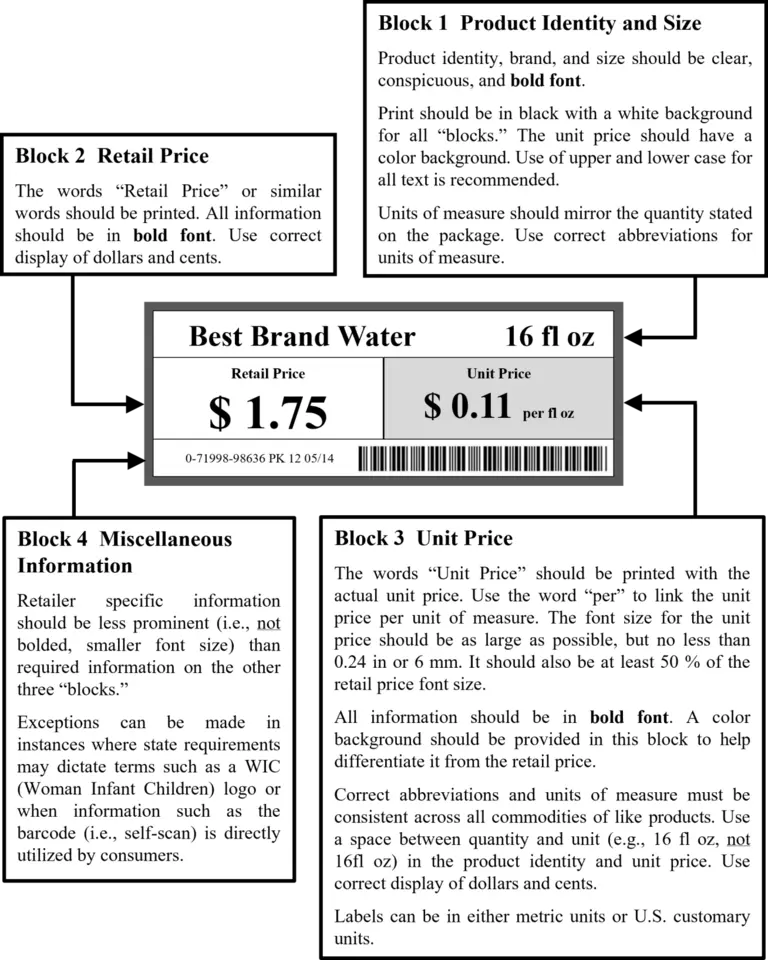
The publication record for the 2025 edition of NIST SP 1181 addresses consistent unit pricing in both physical retail and e-commerce. NIST's instructional diagram separates the pack price from the price per unit of volume, with the product and size identified alongside them. That combination matters more than a number with no unit attached.
Online, compare the size in the selected variant, the description and the cart. If the listing shows conflicting sizes, ask the seller which product will arrive before making the comparison. Using the wrong weight produces a neat calculation with little practical value.
A lower unit price is not the whole decision
Our practical conclusion is that this calculation standardizes quantity, not the products themselves. Ingredients, intended use, storage requirements and a suitable amount remain separate considerations. For example, comparing a liter of concentrate with a liter of ready-to-use cleaner ignores dilution; price per liter alone cannot settle that choice.
A large pack also needs storage space and may go partly unused. After doing the arithmetic, ask a second question: do I need this much? Unit prices make the choice clearer without obliging you to buy more. Before paying, separately check the total including delivery. That is the cost of the order, not just the contents of one pack.
Related reading
Sources
- https://www.bls.gov/opub/btn/volume-12/measuring-shrinkflation-and-its-impact-on-inflation.htm
- https://www.gov.uk/government/publications/unit-pricing-information-for-consumers/unit-pricing-information-for-consumers
- https://www.nist.gov/publications/nist-sp-1181-unit-pricing-guide-best-practice-approach-unit-pricing-2025-ed
- https://www.nist.gov/programs-projects/uniform-unit-pricing-tools-consumers-fight-shrinkflation