Shoppers could pick their own goods, but they did not choose their own route to the till. In the store described in Clarence Saunders's 1917 patent, aisles formed a sequence: enter, encounter the stock, fill a basket and present it for payment. Why give an independent shopper such a carefully prescribed path?
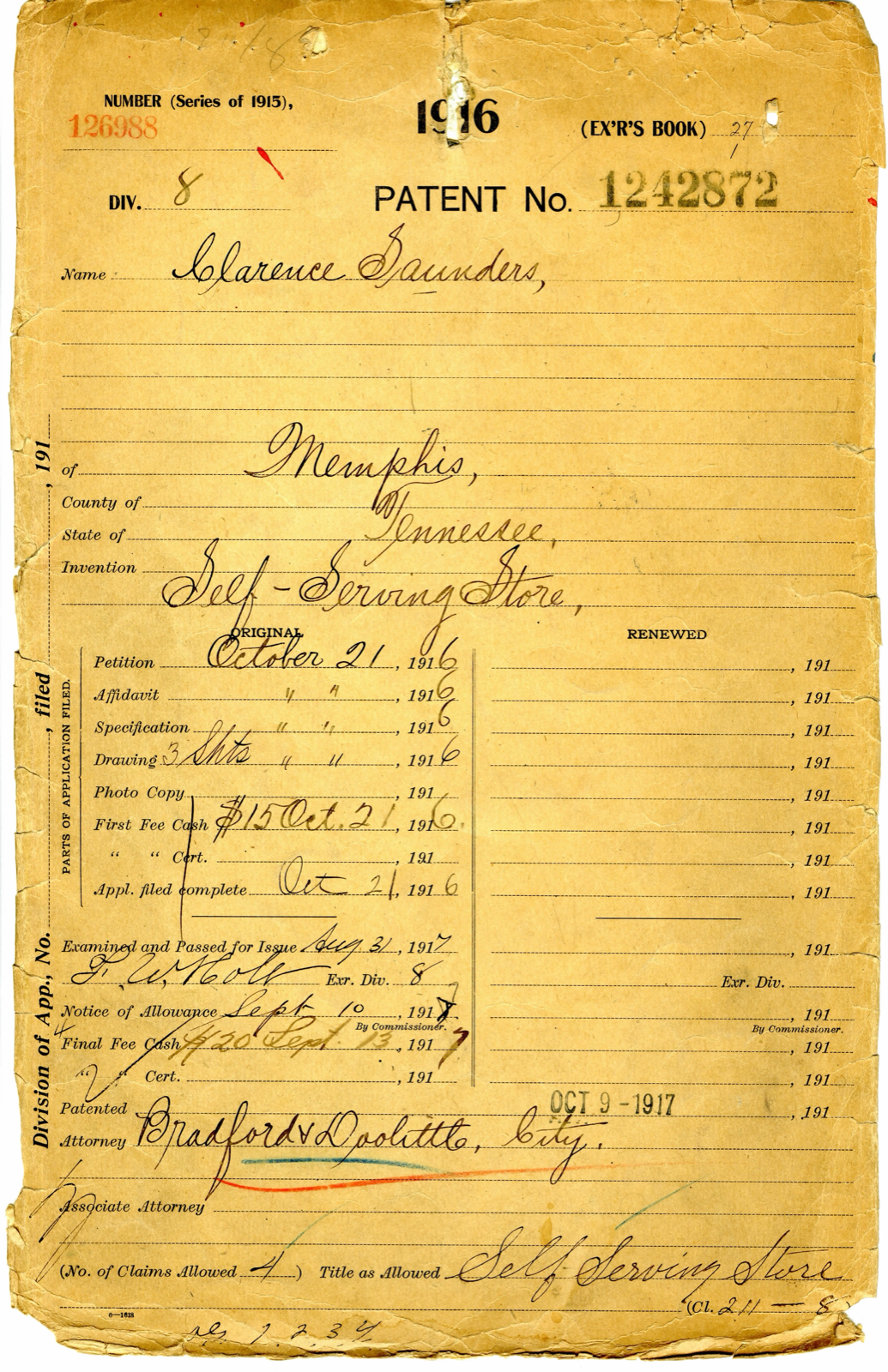
The answer lies in a specific document rather than a sweeping origin story about supermarkets. US patent No. 1,242,872, Self-Serving Store, was issued on October 9, 1917, following an application filed on October 21, 1916. It describes equipment, layout and the movement of people, not simply an invitation to help yourself.
Self-service began at the shelf
Tennessee Encyclopedia traces Piggly Wiggly to the store Saunders opened in Memphis in September 1916. The historical society's account explains his business rationale: customers would collect their goods, then bring them to a clerk for totaling, packing and payment. Saunders expected this arrangement to reduce staffing costs.
That distinction matters. In this account, self-service primarily meant choosing and carrying the merchandise. It did not mean a store without employees, or a checkout where customers scanned their own purchases. In the patent, settling the bill and recording payment remained a separate stage before departure.
Shelves became a route
The description accompanying Saunders's drawings divides the premises into three areas: a front lobby for entering and leaving, a salesroom and a stockroom at the rear. Rows of cabinets and shelves form aisles. Connections between neighboring aisles alternate between opposite ends of the rows, creating one continuous, winding path.
To understand the arrangement, follow a single shopper through the description. This is more than a room where goods happen to be within reach. The shelves lead the visitor past successive groups of merchandise. The opening patent claims explicitly describe aisles connected in this way as part of the proposed apparatus.
Saunders stated that acquainting customers with the full assortment was one of his objectives. The route therefore cannot be explained solely as a convenient way to fit shelves into a room. It also had a selling purpose: expose shoppers to more of the stock while they assembled their own purchases.
The basket's journey ended at a counter
A separate checking area stood at the end of the final aisle. The description even includes shelves on which customers could rest their baskets while those ahead paid. At the counter, the selected goods were checked, totaled and wrapped; payment was taken and the sale recorded on a cash register.
That small detail reveals a second design problem. Letting people choose goods was only part of the task. Their baskets also had to join an orderly queue and pass through payment before leaving. The patent describes one-way entrance and exit gates too. These controlled the direction of travel, rather than identifying the merchandise.
A plan is not proof of a saving
Saunders associated the arrangement with savings in labor and operating costs. A patent, however, records an applicant's design and arguments, not an independent audit of a business. It can establish the proposed sequence of actions. It cannot tell us how many minutes every visitor saved or how much cheaper each basket became.
Nor does a compulsory route measure impulse purchases. The intention to introduce shoppers to the stock is explicit in the source. Establishing that a particular person bought an extra item because of the layout would require a different investigation. No such measurement is offered here.
Choosing goods is not the same as choosing the path
The arrangement supports a straightforward conclusion: being able to take an item yourself does not give you control over the whole shopping process. The store handed over the work of filling the basket while retaining control of the route and the payment sequence. Shopper independence and directed movement could coexist.
For a shopper today, that raises a useful question about any retail setting: which actions do I choose, and which does the seller suggest or require? The comparison can extend to a screen, but it remains an analogy, not evidence that online stores descended from this patent. Saunders's design helps make the shopping process visible; it does not establish that every modern store follows the same plan.