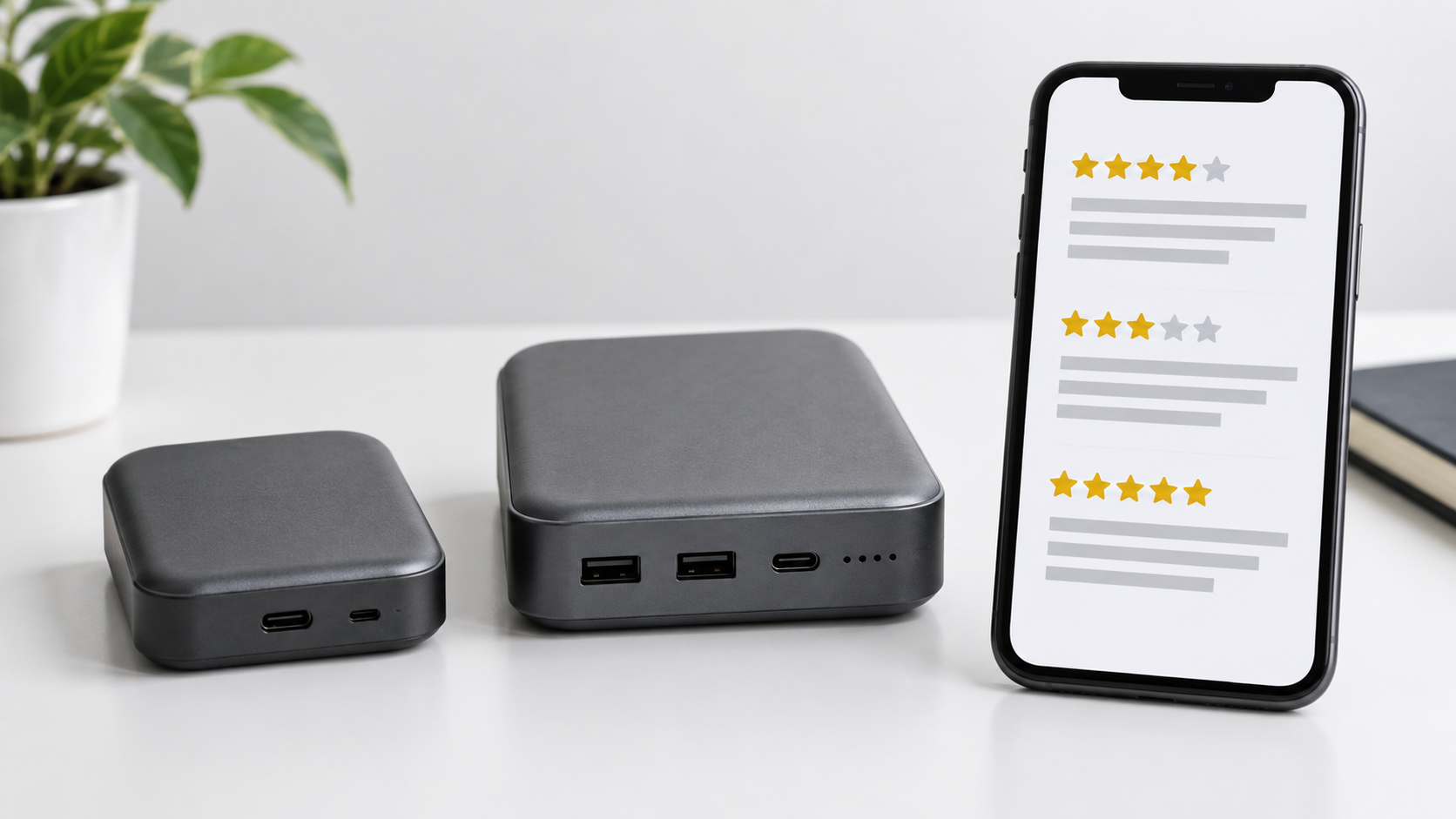
A product page has an impressive rating, yet one reviewer praises a port that the model in your basket does not have. Is the description wrong, are reviews grouped across variants, or is this another product altogether? Before buying, establish not only whether a reviewer seems credible but which version they actually used.
One rating need not describe one product
In February 2023, the US Federal Trade Commission (FTC) accused supplement maker The Bountiful Company of transferring ratings and reviews between products with different formulations, making new products appear more popular. The company agreed to settle the allegations. This was a specific case of misleading review use, not a judgement on every listing with several variants.
Ordinary grouping of closely related variants on one page is a different matter. Even there, the headline star score may describe a broader set of products than the configuration you selected. A sincere review of an earlier version, different size or another configuration may still be poor evidence for your purchase. A mismatch alone does not prove deception; first find out how the site groups its options.
Identify the item before judging its reviews
The FTC's online-shopping guide advises noting the manufacturer or model number, along with details such as size and colour, when comparing items. Apply the same discipline to reviews: record the exact model code from the selected option and the basket, not just the family name in large print. Devices in one family can differ in memory, ports or included accessories; for another kind of product, pack size may be the crucial variation.
Read several substantive reviews. Look for a model number, generation, size or packaging photo and compare that detail with the maker's specification or the selected store option. If the marketplace offers a review filter by variant, check whether the results change when you use it. Do not rely on a picture alone: similar-looking devices can have different specifications.
Consider a hypothetical example. A listing advertises the X series, but your basket contains the two-port X-2. A reviewer describes four ports. Until the discrepancy is resolved, the review cannot confidently be linked to the X-2: the reviewer, seller or description might be mistaken. Do not count it as evidence about the X-2, but do not automatically call it fake either. X and X-2 are fictional models.
Then examine the review itself
The FTC recommends consulting several sources and checking a review's age and the writer's history. It also cautions that appearance alone rarely tells you with confidence whether a review is fake. An incentive label, where the site provides one, adds useful context. Even a genuine review of the correct model is one person's experience, not a failure-rate measurement or a compatibility guarantee.
A practical sequence is simple: confirm the precise variant in the basket, check the manufacturer's specifications, then read reviews for that version alongside independent assessments. If reviews are pooled and cannot be filtered, treat the aggregate rating as less precise evidence. Ask the seller a specific model question and keep the answer with the listing. Separately check the final order total; review quality says nothing about delivery charges or purchase terms.
The lesson is not to abandon star ratings. They can point you towards reviews worth reading. But a decision about a particular item needs the item in the review to match the item in your order. Where that link cannot be established, uncertainty is the honest conclusion, not certainty borrowed from a large rating figure.