At a supermarket entrance, dozens of carts stand in one long row. A shopper pulls a handle and one cart slides free of the next without anyone taking it apart. How does this ordinary trick work, and why did it matter to the store?
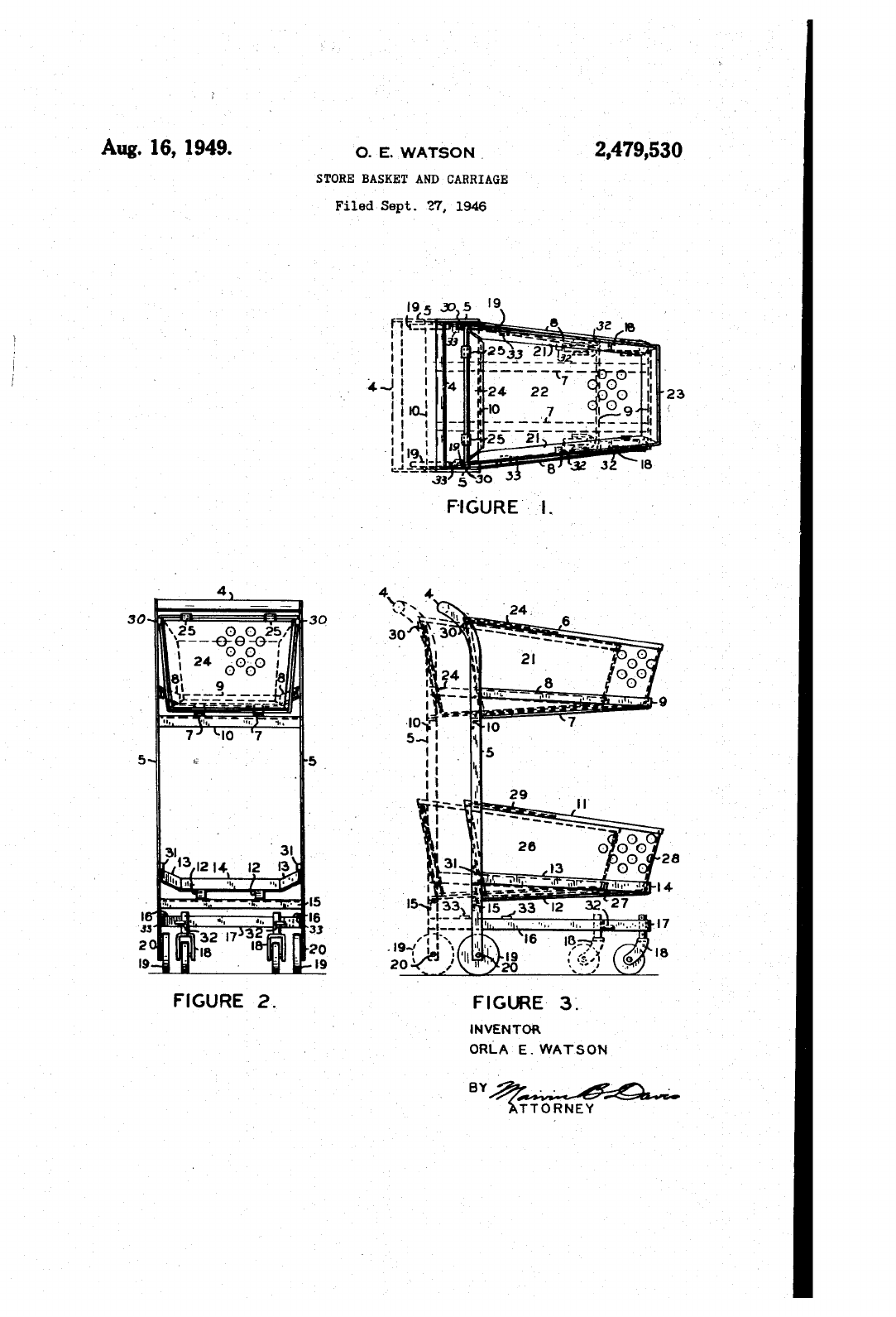
A precise answer appears in Orla Watson's US patent No. 2,479,530, Store Basket and Carriage. Filed on September 27, 1946 and issued on August 16, 1949, it documents a particular answer to a storage problem. Its drawings are not a blueprint for every cart sold today.
Folding was only one answer
Stores already had wheeled baskets. The National Museum of American History holds Sylvan Goldman's folding carriage, a frame that supported two ordinary wire baskets. According to the museum, Goldman filed for that design in 1938 and received a patent in 1940.
With Goldman's design, staff removed and stacked the baskets, then folded the frame for storage. They had to place the baskets back on the frame before the next use, as the Smithsonian's Lemelson Center explains. Watson's later cart could remain assembled while sliding into another cart. That changed a store routine, not merely the appearance of a basket.
A narrowing frame and a moving rear gate
Watson designed the front of each cart to enter the rear of another. The basket and its supporting bars taper toward the nose, and the front wheels sit closer together than the rear pair. When a cart is pushed forward, the frames can overlap instead of meeting end to end.
The basket has a second feature. Its rear wall hangs on a hinge at the top, so the narrow nose of the next cart can push through it. Dashed outlines on the patent's first drawing sheet show one cart inside another. Nesting therefore meant pushing a cart into place, not lifting a basket off its frame.
The patent also describes stops that keep the rear wheels from colliding during this movement. The details matter because compact storage is useful only if carts can be joined and separated quickly while remaining ready for the next customer.
Space for whom?
Watson states the objective in the patent: store wheeled carriages with their baskets still attached while using less floor space. The Smithsonian account supplies a commercial clue. A manufacturer's brochure claimed that each additional parked cart needed only one-fifth the space of an ordinary cart. That is a sales claim, not an independent measurement across stores.
The benefit does not depend on treating that fraction as universal. A nested row leaves more floor area available and keeps carts ready near the entrance. Shoppers experience the other side of the same arrangement: they can take a cart in one movement. Neither the patent nor the museum object, however, measures a change in sales or proves that individual customers bought more.
The invisible work behind convenience
The two designs addressed a related problem with different actions: Goldman's required the baskets to be removed and the frame folded; Watson's could be pushed into another assembled cart. Two modest mechanical choices — a tapered frame and a hinged gate — changed how a store prepared for the next shopper. The familiar ease of taking a cart begins with work that customers rarely see.
Related reading
Sources
- https://patents.google.com/patent/US2479530A/en
- https://americanhistory.si.edu/collections/object/nmah_1194184
- https://americanhistory.si.edu/collections/object/nmah_1216280
- https://americanhistory.si.edu/explore/exhibitions/food/online/new-and-improved/superhighways-supermarkets/supermarkets-symbols
- https://invention.si.edu/invention-stories/reinventing-shopping-cart